Wednesday, April 8, 2009

Examined Life


The other night I went and saw a movie at Cinema du Parc with a friend, a documentary called Examined Life. The film interspersed a number of interviews with philosophers/theorists like Slavoj Zizek, Judith Butler, and Cornel West. Zizek was incredible and totally punk rock, describing the conservative impulse behind ecologist ideology and decrying it, arguing what seemed to be a conception of nature as including humanity and our products. It was a confusing rant that neither I nor my companion completely understood, but it was interesting to watch and intriguing to hear conservative and liberal doctrines reversed with regards to the environment. Judith Butler was in fine form as well, describing frustrating attitudes about human morphology and “correctness” in a conversation with the director’s sister, who suffers from a disease that fuses her joints. It was an interesting discussion of “natural” humanness, and an interesting look at San Francisco, which is evidently very open to disabled people, for lack of a better descriptor immediately on hand.

The real star of the show, though, was West, with his comparisons between jazz and poetry and life and philosophy. The film cleverly used his at the beginning, middle, and end of the film, and he provided not only some of the most poignant moments of empathy but also the best jokes from any of the philosophers. You couldn’t help but laugh with him and take as much pleasure in his ideas as he clearly takes in life. He espoused a day-by-day type approach that really resonated with me, but that I’m having a hard time explaining here. I’m going to link a few videos here to try and give a sense of what he’s talking about, but honestly the movie itself should just be seen, end of story. Maybe I’ll watch it again and take another crack at ths in a more refined form. Cornel's ideas certainly deserve the time and thought. I absolutely loved his citations of everything from Ruskin to Wordsworth to Goethe's The Sorrows of Young Werther, it was a treat to hear him blend in so many different sources into his incredible ideology. What an incredible speaker...

http://www.dailymotion.com/video/x1qc8r_cornel-west-on-knowledge_events
http://www.youtube.com/watch?v=Ex1XV52L3OQ

There's an article on the movie in The McGill Tribune that decently summarizes a few of the speakers, and so I'm posting it here:

FILM: Discussing ethics on Fifth Avenue

Walking and talking with contemporary philosophers in Examined Life

Carolyn Gregoire

Issue date: 4/7/09 Section: A & E
Outside of luxury department store Bergdorf Goodman on Fifth Avenue in Manhattan, philosopher Peter Singer-author of the well-known essay "Famine, Affluence, and Morality"-explains his theories of distributive justice and the ethical implications of wealth and poverty. Singer is one of eight contemporary thinkers featured in Examined Life, a documentary that explores unquestioned assumptions engrained in the Western psyche, and reminds us that great ideas can emerge from everyday life.

Directed by Astra Taylor, the film is structured around 10-minute-long "walks" with philosophers through places that are particularly meaningful to them, ranging from an airport terminal to Central Park. While on a walk through a sunny city park, one of the philosophers, Avital Ronell, introduces the Heideggerian notion of paths that lead nowhere to explain that it's the journey that matters.

Gliding along a moving sidewalk in a major international airport
[Toronto's Pearson - Max], suitcase in hand, Anthony Appiah discusses his theory of "cosmopolitanism"-being a citizen of the cosmos in the Greek sense, or the world as a whole-in the context of globalization and modernity. He explains how in one trip to an airport we confront more people than a member of a primitive civilization would have in a lifetime. University of Chicago professor of political philosophy and ethics Martha Nussbaum walks along the shores of Lake Ontario discussing Aristotle's theory of justice and the social contract, while Michael Hardt talks revolution from a rowboat in the Central Park pond.

Slavoj Zizek, the subject of Taylor's documentary Zizek! which premiered at the Toronto International Film Festival in 2005, also makes an appearance. Zizek discusses his theory of the "ideology of ecology" at a garbage dump. Surrounded by waste, he explains that just as true love is not idealistic but sees perfection in someone even with all of their flaws, we must love the world and see perfection in all of its imperfection.

From the backseat of a car, American philosopher and civil rights activist Cornel West emphasizes philosophy as a way of dealing with our finite situation as human beings. West's humour livens up the film, particularly in his discussion of aesthetic pleasure-he explains that sometimes he'll be reading Ruskin or Melville and will just need to throw the book against the wall because he feels so alive. He compares philosophy to Romantic poetry, Beethoven's sonatas, and the blues to emphasize how invigorating philosophical inquiry can be.

Examined Life promises to be a highly enjoyable and intellectually stimulating experience for philosophy buffs or the naturally inquisitive. However, an hour and a half of continuous philosophical discourse clearly doesn't comprise the ideal movie night for everyone. While the film succeeds in its concept-bringing philosophical theories from academic ivory towers to the real world-it's not particularly well-made and loses momentum towards the end. The music is ill-chosen and at times distracting, while the flat cinematographic style certainly doesn't enhance the overall experience. Those without a strong interest in philosophical inquiry may be hard-pressed to sit through this film without dozing off.

Examined Life succeeds in its endeavor to disprove the common misgiving that philosophy is so tied up in abstractions, circular reasoning, and lofty theorems that it is essentially inapplicable to the real world. Taking a cinematic walk with these contemporary philosophers substantiates Plato's famous dictum "the unexamined life is not worth living," emphasizing that self-examination and the search for meaning extends far beyond the domain of academic philosophy.

Saturday, April 4, 2009

Bear McCreary

I finally broke down and decided to download the musical track that opened the second last episode of Battlestar Galactica season 2, by composer Bear McCreary. A quick sampling of th original soundtracks on Amazon showed me that it was called, appropriately, "Something Dark Is Coming," and in order to get the track I just downloaded a torrent containing all of the music for the first three seasons of the show. I must say, I'm glad I did.

Bear McCreary is an incredibly talented and diverse musician. I've been listening to the others songs that I recognized by their names, such as "The Shape of Things to Come," and I keep finding myself blown away by the music. Completely independent of the show, the composition conveys a range of emotions and influences that simply baffles me. I haven't gotten much out of the battle music as of yet, it's usually tribal influenced and military sounding drums, appropriately, and it does a great job of conveying the excitement when used in the show; on its own, though, the more energetic pieces don't do much for me. When he's left to more contemplative, slow, experimental and classically inspired compositions, though, it reminds me of Bach's Orchestral Suites, which is simply the best compliment I can think of right now. The tracks perfectly acentuate the show, but more than that they stand as unique and awe-inspiring orchestrations of a wide variety of cultural and historical styles.

It's great music to have in the background, while working, which helps since I'm trying to finish up The Aeneid and The Metamorphoses today, but also great music to just listen to and let wash over you. I recalls why I first started to like Broken Social Scene, in whom the layering and building of different instruments reminded me more of an orchestra than an indie band. It's a totally different way of interacting with sound than I typically find from bands, which isn't to speak ill of "bands" or "indie music," or anything of the sort. It's a totally different type of experience.

One of the most unique things about it, for me, if the amount of emotional investment that the music achieves without lyrics. It reminds me of the bands I listen to for the sound of the words as opposed to the meaning, which is even then an unusual thing for me. I'm so wrapped up in lyricism that I often find it hard to simply let the music hit me independent of the lyrical meaning(s), usually they work together to mutual benefit. Here, though, the music is better off without words.

Anyways, I didn't have a point to this rant, I just wanted to extol McCreary a little bit. Anyone reading this (if anyone does) should find a way to listen to these tracks and just feel the sound. Haha, wow that sounds pretentious and emo. Whatever.

Something Dark is coming
The Shape of Things to Come
Epiphanies
Passacaglia
Kobol's Last Gleaming
Roslin and Adama
All Along the Watchtower (amazing reenvisioning)

UPDATE: Open this link (I'd recommend in a new window or tab) to hear a sample from Something Dark is Coming. It comes late in the track, missing the brooding intro, but it's worth hearing nevertheless. Also I'm including a link to McCreary's website, since I should have done that in the first place.

Audio: http://www.bearmccreary.com/audio/bg-somethingdark.htm

http://www.bearmccreary.com

Wednesday, April 1, 2009

Some random thoughts here and there...

The other day I finally ended up watching Dark City, and I gotta say that it's pretty fucking stellar. It was a visual feast and a more poetic, less kung-fu oriented version of The Matrix, which ripped it off to an unbelievable degree. Even the musical tracks and cues were the same. Anyways, I was glad I watched it, and was able to see the influence of Blade Runner, Hellraiser, Terry Pratchet novels, The Truman Show, and Brazil, all at the same time, and that alone is saying something genuinely positive about the movie.

I also watched Troll 2 with Jo, and, well, lets just say that I wanted to watch it after reading Eric Snider's post about it on Cinematical, at www.cinematical.com/2009/03/15/live-from-sxsw-a-troll-2-virgin-no-more. Between the review and the hilarious story of the screenwriter's response and the misunderstanding surrounding it, I was hooked. This excerpt from Snider's review helped too: "And Troll 2 is 90 minutes of almost non-stop laughable ineptitude. Making fun of it is redundant. All you can do is watch it and let its hilarity roll over you."

In the end I found myself recalling Johnny Rotten saying "Ever get the feeling you've been cheated?" The movie was so horrendously bad that at times, yes, it was fall off the couch laughable. It did not require irony to enjoy it. The problem was that the lengths between these moments were long and horrendous and poorly paced, such that the 90 minutes felt increasingly and excruciatingly long. By the end of the movie Jo and I said fuck it and fast forwarded through the last 10 minutes to see clips to get a general sense of how the story ended, we just couldn't bear to actually sit through any more of it.

I don't think I'm going to write about Battlestar Galactica, at least not in any direct fashion. The series is too big to be handled by anything less than a thesis sized essay, and I frankly don't have the energy or desire to put my thoughts together at that length without gaining something tangible from it. My feelings are scattered ad mixed as it is, and I can't address the finale without discussing the fourth season as a whole. Some random points though:

- Callum Keith Rennie, where the FUCK were you for almost the entire second half of season four?! (interrobang) You think that maybe your character would have been, you know, affected by Starbuck's actions in the fate of the human race, or the fact that she was a tangible fucking deus ex machina?! Come on R. D. Moore, it's not like the actor is doing much else, I can't believe that you couldn't get him for the endind of the damn series. Serious bal droppage.

- I seriously uneasy with the Rousseauian (dare I say, Mormonistic?) allegory that the show ended up becoming by having it conclude in our universe, our reality. Laying aside the very serious problems raised by having an entire civilization's fate decided by the primary cast (a consistent issue in much of the show, though admittedly a self-reflexively recognized one), this seemed like another one of the many instances in season four where things "fit" but didn't feel right, felt forced (ie: Ellen and Tory as Cylons, less so Ellen, but Tory?! Fucking Tory?! What about BILLY. That would have been incredibly powerful and affecting and made more sense, and ironically would have made Tory's character more interesting by extension).

Ok, I'm stopping the BSG ranting, this is starting to become what I'm trying to avoid...

I read an essay online about our physical interactions with film, and how it's changing, and I'm trying to work thorugh my thoughts about it. I feel like it relates to my piece on Coraline a bit, and so I'm going to post it here after this paragraph so that I don't lose it when it gets taken offline (it's on a subscription based magazine site). The way the article talks about the changing nature of interaction with media reminds me of Adorno and Horkheimer, and also the theorist (who I can't for the life of me remember the name of) who discussed our interactions with television and other more contemporary medias, and how they worked upon us in a state of distraction. Come to think of it, that might have been Adorno and Horkheimer, or at least they might have touched upon it, though I feel there was another theorist I've read who dealt with it in a more direct way.

In any case, the essay explicitly states its desire to separate itself from mere nostalgia, but I don't think it does. It's not the greatest piece of writing is the real issue, but then who am I to judge? Well I'm going to anyways, and the author spends to much time lamenting how things were "back in my day" to convince me that he's not being nostalgic and damning of new era of physical interaction with cinema. He completely disregards this new form of interaction, not detailing it in any sufficient form, so I can't help but sense his disconnect from it.

Anyways, I think he would be curious to hear my rant about 3D films, it's not exactly what he's talking about, but it is a form of physical interaction with the medium. Maybe if I had missed Coraline in theatres, or spent the next ten years trying to find a 3D print of it to watch on a big screen, then I would be able to write a more appropriate and correlative response to this essay. anyways, without further ado:

CONTEMPLATING THE NEW PHYSICALITY OF CINEMA
MOURNING THE DEATH OF THE FETID, HUMAN WAY WE USED TO INTERACT WITH MOVIES
DISCUSSED:

Black-Market Videotape, The Despised Anglo-American Market, Terrence Malick’s Bedroom, Dank Basement Cinemas, The Cinema Village, The Carnegie Hall Cinema, The Notting Hill, The Accatone in Paris, The Old Cinémathèque Française in Paris, Steenbecks, Le Havre

La Chinoise (France, 1967)" height="230" width="300">

“I am looking at the eyes that looked at the Emperor.”
—Roland Barthes, La Chambre claire

1.

For a particular type of cinephile from my generation—those of us born in the early ’60s and raised on a strict diet of left-leaning, somewhat Eurocentric art and culture—the physical act of seeking out and consuming great or hallowed or mythical films was as obsessive as our need to experience these films, when and if we found them.

When I say physical, I’m talking about the rumors traded among cinephiles, the stories and the clues. We wrote letters to long-forgotten crew members of neglected masterpieces and arranged meetings in difficult-to-pronounce European cities still shrouded behind the Iron Curtain. We sent money orders or contraband to shady PO boxes in hopes of hitting the mother lode. (That’s how I got my hands on Bergman’s Merry Widow script, crafted as a showcase for Barbra Streisand and set aside when it could not be financed.) Did Jacques Rivette’s twelve-hour-and-forty-minute version of Out 1, noli me tangere, supposedly screened at Le Havre in 1971, really exist? Could sequences from the abandoned version of Werner Herzog’s Fitzcarraldo, the one starring Jason Robards and Mick Jagger (before Robards had a massive heart attack and Klaus Kinski replaced him), be bought on black-market videotape? Where could we find films of the Marxist couple Straub-Huillet with English subtitles when the filmmakers themselves had sought to keep their work free of the textual residue of the despised Anglo-American market? And where was Terrence Malick sleeping?

I’m also talking about dark and damp basement cinemas in New York, Paris, Rome, Stockholm, Berlin, and London, places like the Carnegie Hall Cinema, the Cinema Village, and the Notting Hill, where double features were the order of the day. They were cheap and they were brilliantly programmed and we flocked to them in droves. Sometimes you walked up three flights to get to these theaters but they still felt subterranean. You could buy candy and drinks and there was always a smoking section. It was a fetid, human experience.

You could also have a very different relationship with a film depending on where and with whom you watched it. An audience at a university cinema in L.A. had a solemn, nearly funereal reaction to Pasolini’s Salò, based on Sade’s 120 Days of Sodom (they seemed uncertain whether they had just witnessed a film or a crime); later, I watched the same film at the Accattone in Paris with an audience that couldn’t stop laughing.

I watched my first Philippe Garrel film, Les Hautes solitudes, starring Jean Seberg and largely based on her turbulent life story, at the old Cinémathèque Française near Trocadéro. It’s a silent film with an amazing lexicon of bohemian costars, including Nico, Tina Aumont, and Laurent Terzieff, in its cast. What I remember most clearly is the look of sheer terror washing over Seberg’s face in one of those endless black-and-white close-ups on which Garrel built his reputation, and, equally, the mildewy smell of the underground cinema. It had yet to decay to the point where it would become uninhabitable, even for the faithful. When I watched the film there again in 2004 it was pretty much raining inside.

I traveled to Belgium and Holland to watch Garrel’s films on Steenbecks, the now-antiquated editing tables used to cut pretty much every film of the later part of the twentieth century, in the archives of museums so cold I could see my breath. I worried that the prints would be damaged, and once or twice they were. I also remember that the films had their own specific tactility. Touching them was like running my hands along the surface of shattered glass.

But I don’t much value nostalgia. What I am interested in is the possibility that we are passing through a period that portends a death of cinema. I say “a death” and not “the death” because movies will still exist. It’s the way we’re physically interacting with them that may become extinct. The chasing and the yearning and the never-knowing and the suffering in a broken, smelly, damp-cushioned seat. As cinema becomes more portable, more easily created, and less difficult to acquire, it also runs the risk of forfeiting one of its greatest attributes—its physicality. Its necessary exertions.

2.

But the “physical aspect” of cinema, the death of which I’m mourning slightly (only slightly) in advance, doesn’t only refer to the physical act of seeking and watching. This death will necessarily impact the kind of films we make and how we make them.

One can physically crave what the director leaves out or denies his audience. Pedro Costa’s refusal to move a camera for twenty minutes at a time, or to place his speaking subjects anywhere near the center of the frame, creates an intense frisson between the screen and the viewer. Nothing that happens (and very little does happen) in his 2006 film Colossal Youth can account for the visceral response it provokes from audiences. Several lengthy sequences feature the main character sitting on what might be a bed or sofa, talking to an unseen person or persons offscreen about things that are never explained. What we do somehow “get,” almost by osmosis, is the oppressive location of the “action,” the housing projects of Lisbon’s poorest neighborhoods without the use of any classical establishing shots. Costa shows us nearly nothing and tell us less. And yet the result isn’t that we’re bored or disinterested; rather than having all our curiosities passively satisfied, we’re forced to physically desire what we don’t (or can’t) know.

The same can be said of James Benning’s recent films Ten Skies and 13 Lakes. In 13 Lakes, Benning places a camera in front of thirteen different lakes and records each lake for ten minutes. His films deliver a scrim of unmediated authenticity, intensified by the discomforting sense that nothing is accidental—and nothing is. The placement of the camera, the frame, and the duration of the shot are perfectly calibrated by Benning. The physical experience of watching 13 Lakes is in fact nothing like sitting in front of any of those lakes. It is more like watching Benning watching the lakes; the “content”—the plot, if you will—is provided by the oxymoronic presence of this absent figure.

Derek Jarman’s final feature film, Blue, explores the physicality of consciousness. Jarman made Blue when he’d lost his sight, a side-effect of drugs he was taking to combat AIDS. The film uses a pervasive monochromatic blue screen as the “backdrop” over which a sound track of impressions, events, ideas, and reactions to Jarman’s situation is narrated by different “characters” in the film—Jarman, members of his cinematic family, friends. Experiencing the film, the spectator feels he is firmly standing in the geography of Jarman’s mind; the physical sense of being enclosed is both claustrophobic and intimate.

3.

In recent years there has been a tendency by both critics and audiences to dismiss the kind of psychological films (i.e., those that tackle what auterist film critic Robin Wood calls the “Big Issues”) I grew up on, like Bergman’s Cries and Whispers. (Lars von Trier is the exception that proves the rule.) A film like Bergman’s last, Saraband, which reprised his warring couple from 1973’s Scenes from a Marriage some thirty years later, was largely ignored. A young woman who watched the film with me told me she thought those people who talked about their feelings and inner turmoil endlessly were “losers.”

Bernardo Bertolucci calls what some directors are making today post-cinematic cinema, and cites Harmony Korine as a major exemplar of this tendency. Bertolucci stresses the importance for filmmakers of freeing themselves from the pressures of the great cinematic canon; rather than grappling with the anxiety of influence ad infinitum, he believes that practitioners of post-cinematic cinema should avoid it altogether. Korine—who still lists among his heroes Godard and Antonioni—expresses his ideas in a way that probably owes more to music video than to cinema.

Post-cinematic cinema, in other words, more or less takes its cues from reactions to and defenses against distraction and boredom. I’m thinking about the films of Michel Gondry, Paul Thomas Anderson, Charlie Kaufman, and, to a lesser extent, Sofia Coppola. They deal with the notion of offhandedness in a cool but structured way. Viewed through the prism of YouTube, it’s a cinema told from the left and right of the page and via footnotes, as if the essential documents telling the story have been lost, and someone is trying to re-create it. These directors make films you can watch while doing the many other things we do while watching movies now, but that still command our attention.

This may well be the cinema of the future, and it will create a new brand of cinephile, of the sort depicted in Atom Egoyan’s 2007 short called Artaud Double Bill. In it, a woman sits inside a cinema and, using her cell-phone camera, photographs images of Antonin Artaud in Dreyer’s The Passion of Joan of Arc as it is projected on the screen. She then texts them to a friend, adding the message “He is hot.” Her friend sends a text back saying that she agrees. Artaud’s “hotness” is made all the more resonant by a cut to Joan burning at the stake, a clever footnote on montage that recalls Bazin’s thesis on the essential dishonesty of editing and the ease with which one can manipulate the “idealistic phenomenon” that is cinema.

In his way, Egoyan is saying that there will be a future for cinema love and it will be propagated, if not in the same ways we came to love it. It’s an optimistic missive from the old-school cinephile to the new.

C.S. Leigh is a writer and filmmaker.

Tuesday, March 31, 2009

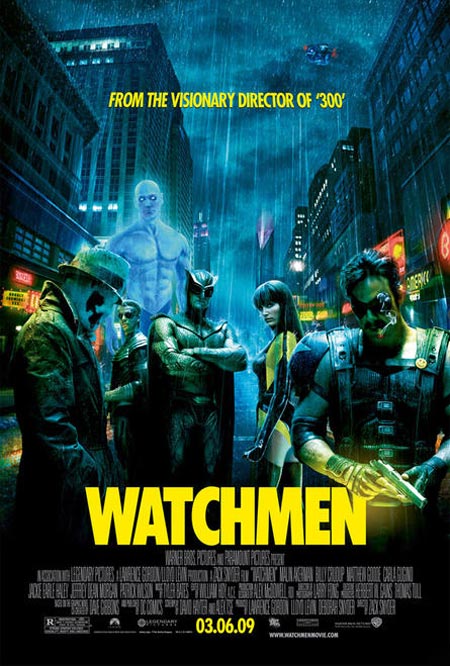
Max's Epic and Inevitable Watchmen Rant


Ok, so this rant just sort of kept going as I got more into it and my ideas got more developed. It’s long, but bear with me. Also don’t bother reading this if you haven’t seen the film or read the novel, I’m pretty explicit with my plot points.

You could write entire books on Watchmen and its adaptation into a feature film. You could talk about the influence of the graphic novel, the cultural weight of the text, the exactitude with which it was crafted, and all sorts of other interesting aspects of the work of art that is quickly becoming franchised. You could talk about the history of its road to the screen, the merits of the final product as a film, what was cut out of the original text and the different versions of the film, the marketing, ad infinitum. What I’m going to talk about are a few moments and aspects of the film that reveal the overall approach to the original text and the resulting thematic feel of the film.

A lot of what the film actually does right has an estranging effect, distancing the audience from the art instead of bringing them into it. Throughout the entire three-hour affair I had an eerie, unshakable feeling that I was gazing into the uncanny valley. Everything is a picture-perfect representation of the graphic novel, from the costumes to the setting to the mise en scène, and that is actually one of the most glaring flaws of the film. There are differences between the mediums of film and graphic novel, and Zack Snyder and co. have done little to account for them. While this does not ruin the movie or the story by any means, it does mar the effect of it. For example, the Minutemen appear exactly as drawn, and instead of evoking a sense of nostalgia, as they do in the book, they again estrange the viewer because they seem so incredibly ridiculous. More profound than the visuals, however, are the times when Snyder’s adherence to the original work damages the story on a tonal level.

At the screening I attended, when Rorschach tells the prison inmates “I’m not locked in here with you, you’re locked in here with me,” most of the people in the theatre actually laughed. This was not the response his words should have elicited, and a big part of the mistranslation was in the transfer of mediums. In the book Rorschach’s words convey all of the terror and dread that the threat of such an obviously and recently dangerous psychopath should through his powerful delivery, or lack thereof rather. The audience doesn’t actually see him make the statement, but rather hears about it through the reflective writings of the prison psychiatrist.

Rorschach’s words are not merely a physical threat but also a statement about the gravity and ferocity of his politics, and they resonate with the psychiatrist so strongly that they slowly deteriorate his marriage and ability to exist in his contemporary American society. The chapter they appear in is concluded with the Nietzsche quote, "If you look long enough into the void the void begins to look back through you," appropriately alluding to the personal and collective implications of Rorschach’s existence. In the context of the novel, on the page, Rorschach’s words convey a harrowing sense of Rorschach as an individual and the seriousness of the situation.

When the same scene plays out on film, however, the statement is merely a brutish threat, as though Rorschach is making sure to beat someone up on his first day in jail to avoid becoming someone’s “bitch.” The entire subplot with the psychiatrist is cut out of the film without seriously degrading the overall story, but the changes to the context and delivery of the line are monumental. The audience I was with found Rorschach’s statement laughable even despite their audible cringes only seconds before when Rorschach poured hot grease on his fellow inmate. Perhaps it was the fact that the threat originates from a skinny ginger doing his best Christian Bale voice, or that he is surrounded by the cast of Oz, or that his delivery is punctuated by an almost vaudevillian slap in the face with a nightstick, but Rorschach’s imposing line simply does not work on film. In fact the entire prison sequence comes off badly, with the climactic murder of Big Figure playing out like a humorous wink at the camera. Rorschach is less the pure force of nature that he was written as, à la Heath Ledger’s anarchic Joker, and more a deranged Saturday morning cartoon character, so wacky that you never know what kind of mischief he’ll get up to next (murdering a midget while he goes to the bathroom, for example).

Jackie Earle Haley is fantastic as Rorschach, his performance is note for note perfect, but with his slight figure, poor grammar, and dialogue that becomes ridiculous when voiced aloud (“This awful city, it screams like an abattoir full of retarded children”), the character is often inappropriately comical in the context of the realistic film. It is the very literalness of the representation of the character on screen that hampers his effect. Robert Frost said “Poetry is what gets lost in translation,” and that seems like an apt summation here. Thankfully, though, it is not applicable to the entire movie.

The film does a very good job of conveying the complexity of Dr. Manhattan and his increasing detachment from his human origins through the impressive performance of Billy Crudup. In some ways the film exceeds the graphic novel: Dr. Manhattan feels more like an omnipotent being in the movie than he comes off on the page through the animation of his spectacular feats and the audible delivery of his lines. Crudup’s often unaffected vocal delivery gives a literal and tangible humanness to the character, more effectively evoking the sense of a lapsing human being and mortal. With the exception of a few brief moments of unnaturalness, Crudup maintains a presence that is subdued, contemplative, and waveringly indifferent, the very essence of Dr. Manhattan. His origin story is truncated and unaffecting, and his increasingly ambiguous temporality is almost completely lost from the story, but it only speaks higher of Crudup’s portrayal that the character remains so powerful, sympathetic, and awe-inspiring in his indefinite position between divinity and humanity. The feel of his character shines through as one of the most effective and respectful aspects of the adaptation.

Salman Rushdie's recent article in The Guardian discussed the tricky business of adapting novels into films, and he observes that “an adaptation works best when it is a genuine transaction between the old and the new, carried out by persons who understand and care for both, who can help the thing adapted to leap the gulf and shine again in a different light.” After seeing the film there is no doubt in my mind that Snyder cares for Allan Moore’s original graphic novel, and his treatment of the adaptation leads me to believe that he very much does understand the content. In a lot of places the film took liberties from the original graphic novel that worked to its advantage: not having Rorschach ape the final horrific moment of Saw was a wise choice, for example.

Snyder clearly felt he understood the original work enough to make minor tweaks to it in order to make it work better on film, but therein lies the problem: he only made minor tweaks. Rushdie also warns that “Those who cling too fiercely to the old text … are doomed to produce something that does not work, an unhappiness, an alienation, a quarrel, a failure, a loss.” The insistence upon visually and structurally capturing the original graphic novel as written is the film’s most serious flaw, creating a sense of the uncanny that unsettles, amuses, and above all distances the audience from the art. With all that in mind, I want to discuss the ending.

So they changed it. They changed the ending to Watchmen… Once the initial shock has dissipated it’s easy to see that the change isn’t really that profound, and actually represents one of the moments of wisdom and courage when Snyder and co. realized that they had to change what was written on the page in order to do it justice on the screen. If only they had done more of it.

They couldn’t have had a giant squid monster materialize in downtown New York, partially merging with buildings and people and leaving a swathe of destruction in its wake. More to the point, they shouldn’t. On the most basic level it would look simply ridiculous on film, more so than it did on the page, and that’s part of the point. Moore’s use of the squid monster necessarily pokes fun at the medium in which Watchmen was originally represented, just as with Adrian’s line “I’m not a Republic serial villain.” Part of the thematic structure of the original work was to at all times be aware of what it was, and to both critique and honour the medium as a way of telling human stories. Even this summation only scratches the surface of Moore’s narrative complexity, and because the film is a different medium than that of the comic book the effect would not be the same. Filmgoers are not used to seeing humans combat giant squid monsters, and so they would be drawn out of the experience in a way that would not have any historical or form related resonance. It was a very good idea to change the ending from the original one, and the changes that were made kept the thematic structure of the narrative largely intact.

The filmmakers effectively made Dr. Manhattan the “dark knight” of late 20th Century world politics. In a way it maintains what Watchmen always was: a story about how it takes a semi-divine scapegoat to serve as an immediate threat in order to unite humanity and save it from itself. In terms of design the ending works perfectly; in terms of its execution, however, there are some issues. The fact that they removed the final scene between Dr. Manhattan and Adrian is a poignant loss because it robs the latter of the humanity he finally achieved at that point in the book. After all his callous murdering and talk of necessary sacrifice, at the end of the novel Adrian shows self-doubt and despair as he questions “God” as to the whether or not he did “the right thing,” and it is in this action that he finally becomes a hero. His final appearance is as a tortured soul, simultaneously proud and ashamed of his actions, and in this he becomes a human being just like any of the other heroes of the story, meddling in grand, complex affairs in his attempts to be something more. Without this, Matthew Goode’s Adrian is only as good as the selected material allows him to be, and that leaves him far too clearly a villain for the purposes of Watchmen.

The attempt to cover the loss of this scene by putting Dr. Manhattan’s haunting final line, “Nothing ever ends,” into Laurie’s mouth just doesn’t work because her character doesn’t have the transcendent knowledge that gives the nonjudgmental utterance so much weight. This is descending to the level of nitpicking, I know, but the scene in question was a cornerstone in the construction of Watchmen, thematically, emotionally, character study-wise, etc., and to remove it without adequately compensating for the loss is a serious blow to the adaptation.

The film stumbles in the scenes following Adrian’s reveal of his plan because the movie struggles to remain frame-for-frame faithful to the graphic novel while at the same time coping with a dramatic change to the content and context of the original work. I maintain that it was a good idea to change the ending, and while the new ending has problems of its own they’re primarily a result of the overarching flaw in the design of the film adaptation: the filmmakers translate Watchmen in the most literal sense possible except for when they don’t. The ending is changed, subplots are lots, and in general the art is not the same despite constantly purporting to be. It tries to simultaneously leave the complex original work completely untouched and also reshape it into something that will work as a movie, and the end product feels fittingly uneven.

So in the end, did I like the movie? Sort of. It was enjoyable if strange to sit through, and I do intend to watch it again come the rumoured five-hour director’s cut. Clearly it was affecting enough to stimulate a rant of epic proportions. I think it’s a case of the unfilmable being filmed competently, though without taking any steps to make it any less unfilmable. It wasn’t bad, but it was misguided. I wish they had more profoundly changed the original text and tried to capture the spirit of the graphic novel, not the literal appearance. What we ended up with was something that looked a lot like Watchmen, and sometimes felt like it, but more often than not served only to remind us of what the original text achieved versus what the film does not. The basic idea of what Watchmen is could be translated to film, but it would necessarily be so drastically different that it would almost be unrecognizable. It would be something new altogether, but that wouldn’t make it unfaithful.

(Originally posted on Facebook on March 10th)

Friday, March 27, 2009

3-D/Coraline Rant (More about 3D really)


James Cameron has said that he thinks the future of film, and visual media in general, is 3-D. He has repeatedly extolled the unrivaled degree of immersion and realism that can be achieved with three-dimensional film technologies, calling it a “form of pure creation where if you want to move a tree or a mountain or the sky or change the time of day, you have complete control over the elements.” When someone like James Cameron goes on record to say what he thinks about the future of cinema, I pay attention.