Spoiler Warning: This post contains significant spoilers for Skyfall. Please do yourself a favour and see the movie before you read any further to avoid being spoiled.
It's been a little while since
my glowing review of Skyfall and I've had a bit more time to ruminate on the film. I stand by my claims that it's among the best Bond movies ever made as well as one of the best films of 2012. In fact I'd go so far as to say it's the most beautifully shot film of 2012 and worthy of praise on "Best Cinematography" lists for years to come. Roger Deakins truly outdid himself with
Skyfall and movie lovers would do well to see it strictly for the camera work in the third act, with the rest of the legitimately awesome aspects of the film serving as mere silver-lining.
However, all that said, I do want to add to my review by recognizing some of
Skyfall's flaws. None of these were issues that escaped me when I wrote my review, but in trying to avoid spoilers I necessarily had to eschew delving into many of them. Also I wanted that piece to convey my overall sense of satisfaction with the film, and nitpicking it to death wouldn't have helped me do so. Finally, the most damning critique I'm going to level against
Skyfall was something that simply took some gestation time to really come together. It began with a sense of unease as the final scene of the film played out, and has evolved to a serious concern that exists at odds with my overall affection for the film.
I'm going to start with my more mundane criticisms of
Skyfall, as I feel there are a lot of problems with the movie that don't really detract from what it's trying to do. For one thing the third act -- which I have repeatedly praised -- feels more than a little out of place. It completely disrupts the flow of the movie and more or less shelves a good proportion of the plot, never to be heard from again. What happened with the chaos Javier Bardem had unleashed on western covert operatives, and specifically the British government? Are we to believe that his plan included letting MI6 capture all of his actual computer records/servers such that he had no additional copies of the list of undercover agent identities? All of that is secondary to
Skyfall's focus on thematic structure, but the fact that the film left those holes open speaks ill of its script. It feels like the movie expects us to forgive it for this, either because it's a James Bond movie or because the third act so effectively forefronts the themes as plot, and while all that's true it still feels like the whole thing could have been tightened up a bit.
Specifically focusing on the third act, it more than just disrupts the plot, rather it's a whole other freakin' movie. Where everything before they head to Scotland is distinctly Bond, the sequence at Skyfall feels like the bastard child of
Home Alone and the last scene in
Unforgiven played in reverse. It's just plain weird to try to watch James Bond make lightbulb-bombs and load shotgun shells into the floorboards, but that doesn't mean it isn't awesome all the while. I absolutely loved the whole sequence; one friend put it perfectly when they said "This is what happens when you let Sam Mendes make a Bond movie," and it's true that everything in Scotland feel like something straight out of
Road to Perdition. It's awesome but it felt distinctly out of place in the context of everything that precedes it. Obviously I wasn't bothered, but I think it's a legitimate concern to wish they had tightened up the script to feel more cohesive and consistent. Again this is an issue with
Skyfall's script as opposed to its execution, and I feel like the way the whole movie played out on screen more than made up for such deficiencies.
On the other side of that spectrum we have Albert Finney's character, who stands out like a sore thumb in terms of
Skyfall's execution. If that old scotsman wasn't meant to be played by Sean Connery then I have no business writing film criticism. Even during my first viewing I could just
feel that the character was a stand-in for Connery as the physical embodiment of the old Bond, and that idea is frankly awesome. If the casting had worked out it would have made the whole Skyfall sequence feel so perfect and thematically in tune, although I think they did a damn good job of it despite the obvious lack of the original James Bond. Part of me did wish they'd found a way to handle it better though, at the very least to make up for the casting failure. I never,
never want to see Roger Moore again (on film or otherwise) but even he could have made the character work better. As it was Finney was totally competent but uncomfortably out of place in a role that he was clearly not meant to play.
Moving away from criticisms of the third act, I've heard a lot of comparisons between
Skyfall and
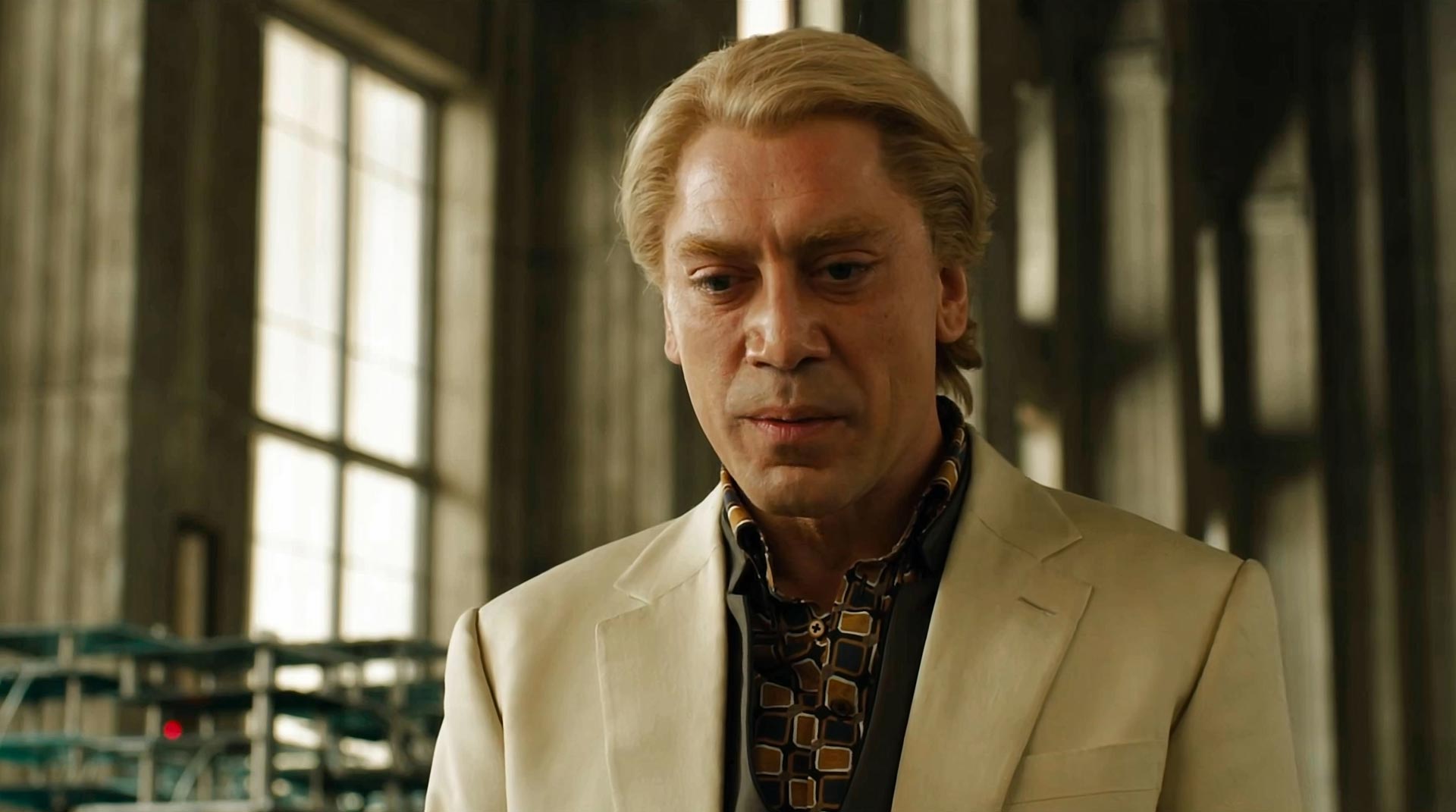
the Dark Knight. I can see why people would compare the two as the plot similarities are undeniable. Bardem's villain also has extremely similar objectives, and on a superficial level he even has a twisted Joker-smile of sorts. In fact I was almost taken out of the movie when I realized that the big twist in Bardem's plan was
exactly the same as Joker's in
The Dark Knight. It's a testament to
Skyfall's overall quality that this aping of
The Dark Knight's plot didn't completely derail the movie; between Bardem's cool creepiness, the third act standoff, all the Bond franchise flourishes, as well as Deakins' aforementioned superb cinematography,
Skyfall manages to carve out its own identity and even surpasses
The Dark Knight in certain ways. Both are great movies, but the similarities are hard to ignore and do take away from
Skyfall a bit.
*
Sigh* And now it's time to get to my real problem with
Skyfall, the big misogynist elephant in the corner that has slowly been sapping my enthusiasm about the latest Bond movie. I felt it in the theatre as I watched Bond walk through the leather door and up to the desk of a male M, the first time I'd seen such a sight in a new Bond movie. At the time I just shrugged it off, but upon further reflection and after a number of discussions with friends I feel it's impossible to ignore the sense that
Skyfall feels like a major step backwards in terms of its sexual politics, even for a Bond movie. But lets work through that statement by inspecting each of the three main female characters in the movie: Sévérine, Eve, and Judi Dench's M.
First off, lets address the seriously problematic character of Sévérine. You probably know her better as "that hot asian chick Bond bangs," since she's barely given anything resembling a character before being carelessly executed without even a moment of reflection. In fact, shy of her physical characteristics, the closest thing we get to a characterization of her is that she's afraid and a (possibly former) sex slave. I don't know if the filmmakers threw in that last reference to make us sympathize with her or to hint at their ultimate treatment of the character, but pretty much her only roles in the film are to movie the plot forward and get naked. It can't be stressed enough that Bond's ultra-creepy sneak-up-on-her-in-the-shower-for-surprise-sex move is
not acceptable, and is hopefully among the traditional vestiges of the past that are thematically shrugged-off over the course of
Skyfall. The problem is that there's nothing to justify such a reading within the film, and in fact it seems like the opposite is true. Bond's "return-to-form" moment comes after Bardem executes Sévérine, a move which poises her as an object.tool of his evolution/development at the script level. There is a potential argument that Bond couldn't express remorse while under fire, and that in fact his transformation back into a competent agent comes as a result of Sévérine's death impacting him severely and thereby telegraphing his need to "be Bond" again. However I don't think there's much justification for this in
Skyfall, and on the contrary it does seem like the movie uses her as a traditional Bond girl/narrative device/sex slave. So that sucks, to start with.
Now lets consider Naomie Harris' "Eve," AKA Moneypenny. I love Harris in everything she does, and I both saw the Moneypenny reveal coming a mile away and loved the fact that they chose such a competent actor for the role. But that said, the mind reels at the sexual political implications of her turn from field agent to secretary. As Eve she initially seemed like a wonderful breath of a fresh air, a female agent at Bond's level who's totally fucking awesome to boot. But then her character is systematically undermined as an incompetent weakling over the course of the film, well-intentioned but better off as eye-candy behind a desk. The film
went out of its way to make a callback to
Casino Royale with the "don't touch your ear" show of incompetence, and the only purpose of this in
Skyfall is to demonstrate how bad Eve is at being a field agent compared to Bond. On top of that there's the whole "she accidentally shoots England's best secret agent" thing. Clearly the filmmakers did not want us to have a lot of faith in her competence, for the exact purpose of making it seem rationale and acceptable that she doesn't want to be a field agent anymore. Of course that makes "common" sense, some people (i.e. women) just aren't suited for it, right James? I suppose all of this could be seen as conjecture, a feminist-oriented over reading of a Bond film to try to find a sexist undertone that isn't really there. Only they follow up that development with the reveal that she's taking a desk job as M's secretary. For f
ucking real? They literally chain her to a traditional gender role in a movie that's explicitly about updating the past to make it suited for and relevant in the present day. As I said, the mind
reels at the implications, and it's a serious knock against the movie that it re-institutes the traditional gender dynamics that the Bond franchise has long been (rightly) critiqued for.
And that's without even beginning to touch upon the whole M thing.
I'll start by saying that Judi Dench is in characteristically badass form in
Skyfall. There's nothing wrong with her or her character in any way that I've noticed/care to consider, and my only regret it that she's exited the franchise. Partly that's because I'm going to miss her as she's an absolute pleasure to watch onscreen, but it's also because I'm not totally comfortable with going back to a male M. As I mentioned in my initial review,
Goldeneye was my introduction to the Bond franchise and so my knowledge of earlier Bond films/tropes has come via films that have always seemed (to me) like relics of the past. This includes the positively rampant misogyny of earlier Bond films, and part and parcel with that trend was the institutional structure of MI6 with Moneypenny as the sole female and secretary for Bernard Lee's male M [
Aside: implicit in this entire argument is the fact that I don't believe for a second the contemporary Bond films have completely shed their misogynist roots. Also, I would love to see a Bond film that passed the Bechdel test, and if I've somehow missed that one already exists please let me know].
Skyfall presents the first time I've seen a male M in a new movie, and from that perspective the sight of Bond walking through the leather door into Ralph Fiennes' office felt like a step back into the literal and figurative past. I was (and continued to be) extremely conflicted about it: on the one hand I ate up the way the franchise's classic elements were re-instituted in
Skyfall's final scene, bringing back the classic Bond in a viscerally satisfying way; on the other hand it felt like those elements brought back the old, unpleasant gender dynamic implications they always had. I'm not sure if this was more a result of
how the movie brought back Moneypenny and a male M as much as it might be inherent in those concepts, but either way the end of
Skyfall felt both like a return to form and a regression to problematic politics. I'll be curious to see how future Bond movies handle the reintroduced elements, as I could easily see Moneypenny being used less as a mere secretary and more as a sort of body guard, but that doesn't take away from the reduction of her role to one distinctively less than Bond and M as the more important
men of MI6. As compared to Judi Dench's positively badass introduction in
Goldeneye, which felt every bit like a defiant rejection of what had come before (particularly the "your predecessor kept some Cognac" exchange),
Skyfall feels like reestablishment of the old guard. Finnes character and performance don't themselves do anything to add to this, but the cumulative impact of him replacing Dench after she's killed off, in addition to how
Skyfall puts Moneypenny in the corner behind the desk, makes the film seem like a major step backwards in how the franchise treats women. It's even more surprising that
Skyfall does this so potently given that it's a Bond movie, a designation that on its face seems synonymous with patriarchal gender hierarchies on film.
In updating the franchise for the modern day,
Skyfall somehow manages to make it seem more out of place than ever in terms of its sexual politics. That's a notably unfortunate achievement that shouldn't be ignored in the face of how successful
Skyfall nevertheless is as a film.
Anyway, that's my two cents on the problems with the film. I maintain that it's an incredible movie that stands among the best of 2012, and more than that one of the most beautiful movies I've ever seen. Period. I just wish it had done all that while maintaining a tighter script and (more fundamentally) without appearing to reinstitute the traditional gender dynamics that the Bond series seemed to have grown beyond (or at least partially ameliorated) during what we can unfortunately now refer to in the past tense as "the Dench years." Hopefully the next one will be able to at least match
Skyfall and also gain back some ground on the progressive gender portrayal spectrum. All we know for sure is that "James Bond will return."