Monday, May 31, 2010

Go See The Trotsky


On Friday I went to see The Trotsky, a new Canadian film about a young man named Leon who's convinced he is the reincarnation of famed Bolshevik Leon Trotsky. Leon tries to emulate every aspect of the historical Trotsky's life, and the film depicts his efforts to found an empowered student union at his Montreal West high school. Starring Jay Baruchel, The Trotsky is in limited release right now and you should go see it because it is great and deserves your support. And how often can you say that about mainstream Canadian cinema?

The Trotsky isn't what I'd call deep or psychologically complex, but it is a lot of fun. This is a real "for the love of the game" type movie, expertly crafted entertainment that relishes in the joy of story-telling. It's a hilarious underdog tale that dives headfirst into its ridiculous premise and makes you root for the least likely candidate. The Trotsky features an exceedingly clever and tightly-written script and an outstanding cast including Saul Rubinek, Michael Murphy, and Colm Feore. And Jay Baruchel...

In talking about The Trotsky it's important that I mention how much I usually detest Baruchel. He's been in a lot of movies and television shows that I really enjoy (Undeclared, How To Train Your Dragon, etc.) but something about him just rubs me the wrong way. I'm not saying that he's a bad actor (though talk about one-note), merely acknowledging my personal bias against him. Because despite my prejudice I still managed to wholeheartedly enjoy The Trotsky, and not in spite of Baruchel but because of him.

The movie seems to be written with an awareness of how annoying Baruchel can be, and a major focus of the plot is how people who hate him come to appreciate and support his cause. It's not that he acts any differently than in previous roles, rather the film seems to be specifically designed to capture his personality and endear it to the audience. By the end of The Trotsky I too was cheering Baruchel on and enjoying his typical nerdy whining as Leon, and honestly I don't think there's any other actor who could have brought the quirky character to life. Baruchel carries the movie and in turn it carries him. This truly is the epitome of a breakout leading performance.

 Jay Baruchel: Surprisingly great in The Trotsky

To reiterate: Jay Baruchel = remarkably awesome; The Trotsky = outstanding; You = should go see the it.

New Scott Pilgrim Vs. The World Trailer

A post at /Film has alerted me that there is a new trailer for Scott Pilgrim Vs. The World up on Facebook. I am including it below:


My excitement for the film is palpable, by which I mean that it is capable of being palped. At the same time I doubt it'll be anywhere near as good as the books. That's not to say the movie won't be earth-shatteringly awesome, but rather that the books set the bar so high that I'm lowering my expectations in preparation. I want to enjoy this film for what it is, not what it isn't, and then pontificate about the difference.

We shall see what Edgar Wright hath wrought come August 20th.

Wednesday, May 26, 2010

Glee On The Word "Fag"

Last night's episode of Glee featured a great scene that I was surprised to see on network television. In it the show's writers explicitly address derogatory use of the word "fag" and identify it as a hateful slur on the same level as words like "nigger" and "retard." It's an extremely powerful sequence that sends a fantastic message and I want to share it because the statement it makes cannot be reiterated enough.

To give a little context, in this episode Finn, a typically moral football player, finds out he's moving in with Kurt, a gay classmate and fellow member of the Glee club. Finn's mother recently started dating Kurt's father, Burt, who quickly became an important masculine role model to Finn. When Finn and Kurt start sharing a bedroom it puts a lot of stress on both of them, and the rising tension finally explodes in this fantastic scene:

I'm going to try to have a better clip soon

I don't have anything to add to Burt's speech, it's a powerful testament to the fact that using such hateful language is disgraceful. Considering Glee's popularity it's always admirable when the writers tackle important social issues. They're quick to criticize rural American culture but clearly aren't blind to their own faults, as seen in episodes like the racially-charged "Throwdown." There's also a brutal honesty to Glee that saves its moralizing from sounding like the stuff of after-school specials, as seen when they discussed disabilities in "Wheels." Burt's speech this week exhibited each of these strengths as he admitted his own guilt in having shared a hateful prejudice and indicted its perpetuation. Because so many people watch Glee it presents a a real opportunity for positive cultural influence, and moments like this show the writers are taking that possibility seriously.

If the sequence above had taken place in reality I would accuse Burt of being overly hard on Finn. The kid has repeatedly shown that he has a good heart and more than that he's struggling with his own serious issues. There's no doubt that Finn's treatment of Kurt is reprehensible, but Burt should have handled the situation better. He has taken it upon himself to become a father-figure to Finn, yet his exemplary criticism of the boy's language quickly devolves into an excommunication. Finn is wrong and he isn't Burt's real son so he has to go. No high school kid deserves to be so brutally devalued and disowned, period.

But this isn't reality, it's the television show Glee, and an episode entitled "Theatricality" no less.  Finn's a good kid, the audience likes him, and so hearing him use the word "fag" is especially shocking. Burt's rage is  righteous but hard to watch with Finn on the receiving end, and the divide between the audience's loyalty to Finn and their moral sensibility makes the whole event feel especially tragic. This elevated drama makes the scene all the more effective in sending the message that words like "fag" are hateful, hurtful, and unacceptable.

Tuesday, May 25, 2010

Thoughts on Dead Space and Horror


Fair warning: this post is particularly rambly, even for me.

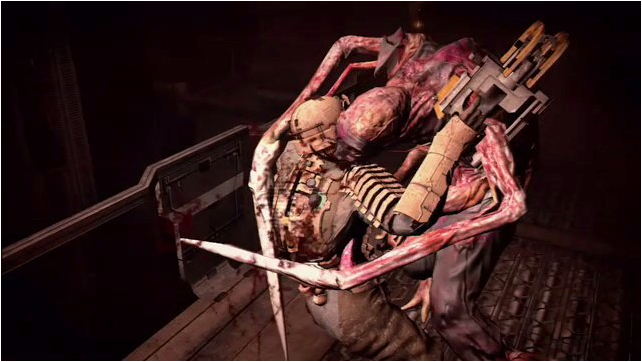
I recently finished EA's 2008 survival-horror game Dead Space. The game's basic premise is "zombies in space," and in a lot of ways it resembles a futuristic Resident Evil.  It's also hugely influenced by films like Alien, Event Horizon, and The Thing. Seeing as how I adore all of those things it was no wonder that Dead Space would spark my interest, and having played through it I am happy to say that the game is awesome. It manages to keep you in constant suspense by cleverly utilizing horror tropes to create an unpredictable and terrifying atmosphere. On top of that the innovative strategic dismemberment gameplay mechanic demands that you approach each regular enemy differently, and the results are always ridiculously gruesome.

Dead Space has been out since 2008 and so it has already received massive amounts of coverage and a prequel, and next year it will be followed by Dead Space 2. I'm really excited for the sequel because it sounds like the developers are going to fix the only major problem with the original game: the story. Dead Space fails to emphasize its underlying story through gameplay and instead tasks the player with a series of contextually necessary objectives. In the end the only real accomplishment in the game is sheer survival, which is great but not substantial enough to really excite. There's also the fact that the protagonist, Issac Clarke, is a silent protagonist, an archaic gaming trope that invites the player to project onto the hero so as to give them a character; it's a bit of a cop-out writing-wise but nevertheless can be effective under the right circumstances (see Half-Life or Zelda). But Dead Space foregrounds Issac's development, particularly his declining mental stability, and given this focus it's counter-intuitive to make him silent and devoid of personality throughout most of the game.


I'm pretty late to the Dead Space party but I don't seem to be the only one: Scott Juster at Experience Points put up an excellent review of the game literally the day after I finished playing it. His post is well worth a read and he's now written a follow-up piece detailing how the game effects a horrific transformation in both Issac and the player. It's based upon a theory that Gerard Delaney posted at Binary Swan to describe how the real monsters in zombie movies are the human protagonists.

Even if you're not interested in Dead Space, Delaney's post makes some good points about the zombie genre, something I haven't thought about in a long time. It got me thinking about some of my favourite horror tales, including zombie movies, the sci-fi films mentioned above, and even a few classic novels and short stories. Far from being unique to the zombie subgenre, a lot of the most horrifying stories show monstrous transformations in their protagonists. The Thing, for example, focuses on the effects of paranoia by introducing a hostile, shape-shifting alien into a group of men. The Descent likewise examines how interpersonal relations and social niceties break down when a group of friends gets lost in an unexplored cave system.

Monsters and villains can be terrifying, but it's truly horrifying when protagonists are compromised. These are the characters we most easily identify with and so we can understand and even relate to their transformations, which in turn invites us to examine our values and limitations. Juster makes a compelling argument for Dead Space achieving this, but I think he's mostly projecting his own reaction to the sheer amount of gore that results from severing enemy limbs. Issac isn't defined well enough as a character to have a real transformation, he remains at all times a silent protagonist that stands as a placeholder for the player. He is what we put into him, no more, no less.

Dead Space succeeds in creating a terrifying atmosphere and repulsive gore, but there's just not enough to the game's characters or objectives. Hopefully the next one will fix this by giving Issac a voice, although it'll take more than that to make the story both horrifying and compelling.

Little Girl Writes to Nintendo, Gets Free DS


Definitely the cutest thing I've heard in a while. That's pretty awesome of Nintendo.

Via Kotaku.